How to Migrate MailEnable Emails to Office 365, Outlook 365, and Outlook Online Account Directly ?

You can migrate MailEnable emails to Office 365 directly using the Turgs MailEnable Migration Tool. It reads MAI files from your MailEnable server, lets you filter by folder or date, and uploads everything to your Office 365 account. No MailEnable installation is needed on the migration machine.
MailEnable is a solid on-premises email server for Windows, but most organizations are moving to cloud-based platforms. If you’re planning a MailEnable to Office 365 migration, you need a tool that can read MAI files natively and upload them directly to Exchange Online without manual conversion steps.
I’ve seen IT admins spend days trying to export MailEnable data through IMAP or manual PST workarounds. There’s a faster approach: use a purpose-built migration tool that handles the format conversion automatically.
Why Migrate MailEnable to Office 365?
MailEnable served organizations well for years, but cloud email platforms have become the standard. Here’s why teams make the switch:
- Office 365 requires no on-site server maintenance or hardware refresh cycles
- Microsoft handles uptime, security patches, and storage scaling automatically
- Teams, SharePoint, and OneDrive integration works natively with Exchange Online
- Remote access and mobile sync work out of the box without VPN or ActiveSync configuration
- Compliance tools like eDiscovery, retention policies, and data loss prevention are built in
The migration itself is the hard part. MailEnable stores emails in MAI format, which Office 365 doesn’t understand natively. You need a tool that bridges the two.
MailEnable Migration Tool Overview
The MailEnable Migration Tool by Turgs reads MAI files directly from your MailEnable server and pushes them into Office 365 via the Exchange Web Services API. You don’t need MailEnable installed on the machine running the migration.
The tool handles emails, contacts, and calendar items in a single pass. You can run it on any Windows machine with network access to your MailEnable data directory. The tool supports migrations to Office 365, Outlook.com, and on-premises Exchange.

How to Migrate MailEnable Emails Step by Step
The migration takes about 20 to 30 minutes to set up for a typical organization. Here’s the complete process:
Step 1: Download and install the tool on a Windows PC that can access your MailEnable data directory. Launch the application after installation.
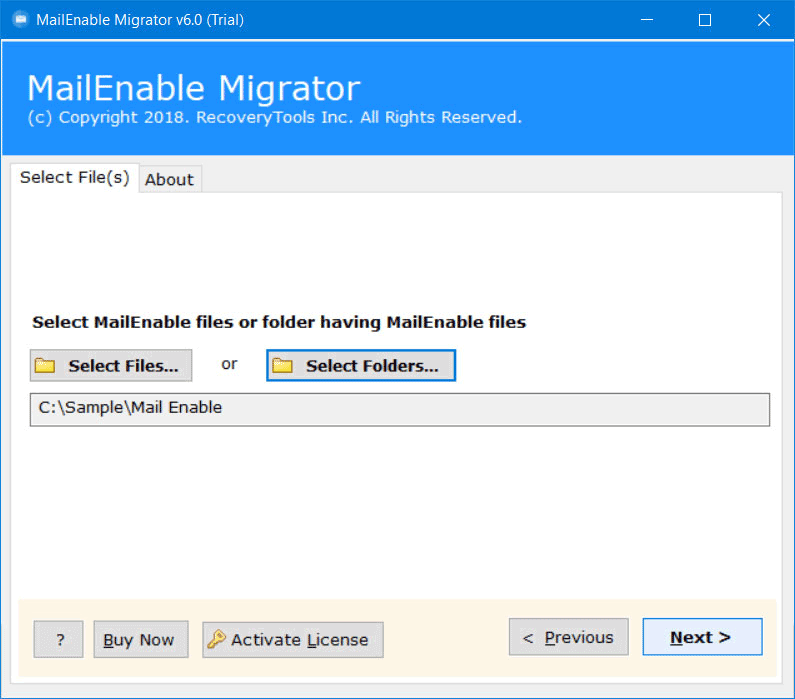
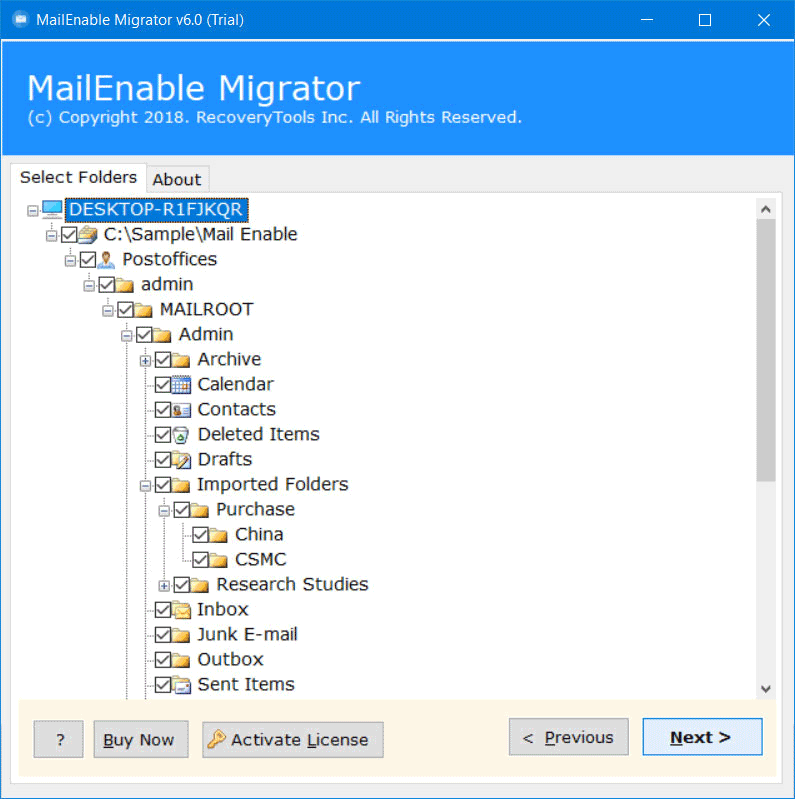
Step 2: Browse to your MailEnable MAI files. The tool provides a folder browser to locate your MailEnable database. Select the root directory or individual mailbox folders you want to migrate.
Step 3: Select Office 365 as your destination. In the saving options, choose Office 365. The tool also supports on-premises Exchange, PST, MBOX, and other formats if you need them.

Step 4: Set language options if needed. The tool allows you to change the email language encoding during migration. This matters if your MailEnable server stored emails in a non-English locale.

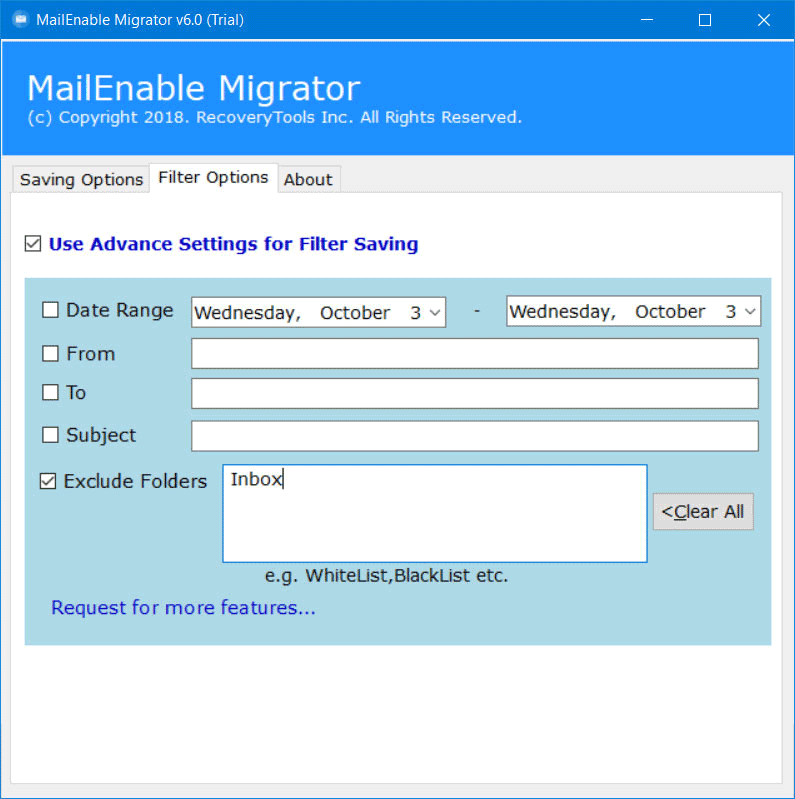
Step 5: Apply advanced filters. Filter by date range, folder, or item type. For large migrations, filtering by date lets you migrate recent emails first to minimize downtime.
Step 6: Enter your Office 365 credentials. Type the admin email and password for your Office 365 tenant. The tool connects via EWS, so make sure EWS is enabled in your Exchange Online settings.

Step 7: Click Convert to start the migration. A progress bar shows the status per mailbox. For large organizations with hundreds of gigabytes of mail, plan for an overnight run.

When the migration completes, users can log into their Office 365 accounts and find all their MailEnable folders and emails exactly as they were.

Key Features of the MailEnable Migration Tool
Here’s what separates this tool from manual migration workarounds:
No MailEnable installation required. The tool reads MAI files directly from disk. You don’t need a running MailEnable server on the migration machine. Copy the data folder to any Windows PC and run the migration from there.
Direct upload to Office 365. Emails go straight into Exchange Online without creating intermediate PST files. This eliminates a full export-import cycle and reduces migration time significantly.
Migrates emails, contacts, and calendars. All three data types migrate in a single pass. You don’t need separate tools or multiple runs to cover all your MailEnable data.
Dual selection mode. Select multiple MAI files or entire mailbox trees at once. For organizations migrating 50+ mailboxes, this saves a lot of manual selection time.
Advanced date filters. Migrate only emails from the past 12 months, or limit migration to specific date ranges per mailbox. This helps organizations with compliance requirements control exactly what moves to the cloud.
Language encoding support. MailEnable servers running in non-English environments sometimes store emails with alternate character encodings. The tool handles re-encoding during migration to prevent garbled subject lines or body text.
Limitations to Know
Limitations
- The tool runs on Windows only. Linux or Mac environments are not supported for running the migration software.
- Exchange Web Services (EWS) must be enabled in your Office 365 tenant. Some newer tenants disable EWS by default as Microsoft transitions to the Graph API.
- Very large migrations (500 GB+) benefit from a dedicated network connection. Consumer-grade internet with upload speeds under 10 Mbps will significantly slow the process.
- The free trial limits the number of emails that migrate per folder. A full license is required for a complete organizational migration.
- Public folder migration is not supported. Only user mailboxes, contacts, and calendar items migrate.
- MailEnable MAI files from very old versions of MailEnable (pre-v3) may require manual validation before migration.
Frequently Asked Questions
Do I need MailEnable installed to run the migration?
No. The tool reads MAI files directly from disk. You can copy the MailEnable data folder to any Windows PC and run the migration from there without a running MailEnable server.
Does the tool migrate contacts and calendars along with emails?
Yes. The tool migrates emails, contacts, and calendar items in a single pass. You select which item types to include before starting the migration.
What version of Office 365 is required?
Any Office 365 plan that includes Exchange Online works. Business Basic, Business Standard, Microsoft 365 Business, E1, E3, and E5 plans all include Exchange Online and are compatible.
Can I migrate selected mailboxes instead of everything?
Yes. The dual selection mode lets you choose individual MAI files or specific mailbox folders. You can migrate one user at a time if you prefer a phased approach.
How long does a MailEnable to Office 365 migration take?
A 10 GB mailbox migrates in about 60 to 90 minutes on a standard business internet connection. Larger organizations with 100+ mailboxes should plan for an overnight or weekend migration window.
Is the migration process safe for sensitive email data?
The tool uploads data directly to your Office 365 tenant over an encrypted HTTPS connection. Your email data does not pass through any third-party servers during the migration process.